







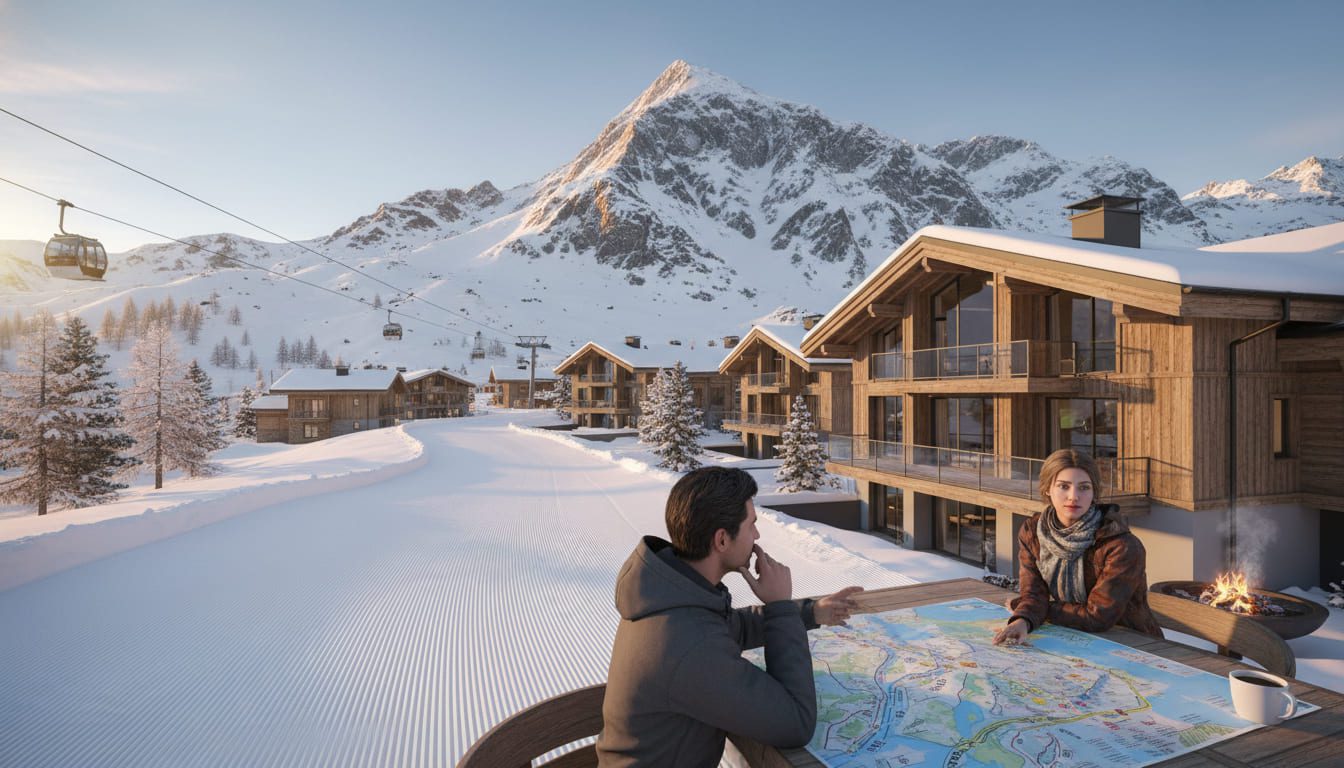
Sitting in a drafty gondola ascending the Aiguille du Midi during a particularly brutal whiteout, I realized how dramatically the logistics of mountain travel had shifted. The wind howled against the scratched plexiglass. Beside me sat two local freeriders reviewing topological maps on their weather-sealed tablets. My own journey to that precise high-altitude moment took months of meticulous planning of ski holidays. Winter mountain travel demands a respect for logistics that summer beach trips simply do not. You are actively battling gravity, sub-zero temperatures, complex global supply chains, and dynamic weather systems.
Executive Summary for Ski Holidays
| Strategic Pillar | Key Considerations | Expert Recommendation |
|---|---|---|
| Resort Selection | Altitude, micro-climates, transfer times, terrain variety. | Target resorts with village bases above 1,800m for snow security. |
| Financial Planning | Dynamic lift ticket pricing, multi-resort passes, currency fluctuations. | Secure Epic/Ikon or regional passes 6-8 months prior to travel. |
| Equipment Logistics | Airline baggage fees versus rental costs. Boot fitting priorities. | Always purchase custom-fitted boots; rent skis if flying transatlantic. |
| Risk Management | Off-piste exclusions, helicopter evacuation, trip cancellation. | Acquire specialized alpine insurance detailing search and rescue limits. |
Successfully orchestrating ski holidays requires treating the endeavor less like a vacation and more like a tactical deployment. Mistakes carry literal and financial weight. Choose the wrong week, and you are skiing through knee-deep slush. Book the wrong transfer, and you miss your flight out of Geneva because a sudden blizzard closed the valley roads. The margin for error is razor-thin.
The Shifting Economics of Modern Ski Holidays
Corporate consolidation has fundamentally rewritten the financial rulebook for winter sports. We are witnessing an oligopoly in mountain management. Two major players dictate the market dynamics across North America, and their influence is actively bleeding into the European Alps and Japanese ski domains. Walk-up ticket window prices at premium North American resorts routinely exceed $299 per day. Such figures render traditional single-day ticket purchases financially irrational for most traveling skiers.
I track these pricing architectures obsessively. The strategy relies on locking consumers into multi-resort mega-passes purchased during the preceding summer. This shifts the financial risk of poor early-season snowfall from the resort operators to the consumer. For the traveling skier, this requires committing to your primary winter destination half a year in advance. If you fail to secure these passes before the autumn deadlines, your alternative is paying extortionate daily rates or restricting your travel to fiercely independent, secondary mountains.
European ski holidays still offer a fascinating counter-narrative to this North American model. The Alps operate largely on valley-based consortiums rather than single corporate ownership. A massive interconnected domain like Les Trois Vallées in France allows you to traverse 600 kilometers of piste on a single pass that costs roughly half of what a comparable North American daily ticket demands. The trade-off? European resorts frequently charge extra for infrastructure you might assume is included, and their lift networks can be a chaotic blend of state-of-the-art heated bubble chairs and terrifyingly antiquated surface tows.
Resort Architecture: Alps vs. Rockies
Understanding the topographical philosophy of your destination is critical. The physical layout of a mountain dictates the rhythm of your day. In the Rocky Mountains, resorts practice a ‘boundary-to-boundary’ management style. If it is within the ski area map and not explicitly roped off, it is avalanche-controlled and patrolled. You can confidently dive into dense glades or steep bowls knowing explosive mitigation has occurred. This creates a specific style of tree skiing and freeriding that defines the North American experience.
Conversely, the European Alps operate on a vastly different legal and physical framework. European ski domains focus on the concept of the ‘piste’. The groomed trails are secured, patrolled, and avalanche-mitigated. The moment you slide one meter off the marked trail, you are entirely responsible for your own survival. There is no active avalanche control in the off-piste sectors unless it directly threatens a groomed run below. This harsh reality completely alters how I approach terrain when crossing the Atlantic.
Furthermore, European resorts excel in lateral expansion. You might start your morning in Switzerland, ski across a high alpine saddle for lunch in Italy, and return before the lifts close. This village-to-village transit offers a romantic, exploratory dimension to ski holidays that a monolithic, single-base North American resort struggles to replicate.
Advanced Selection Criteria for Ski Vacations
Novice planners stare at trail maps. Experts analyze micro-climates. A mountain’s geographic orientation and proximity to specific weather patterns govern its snow reliability far more than absolute elevation. I have skied chest-deep powder at 1,500 meters in Japan because of freezing Siberian winds crossing the Sea of Japan, while simultaneously watching resorts at 3,000 meters in the Southern Alps struggle with rain due to the warm Föhn wind.
When evaluating destinations for ski vacations, you must dissect the historical snowfall data alongside the resort’s artificial snowmaking capabilities. You cannot simply trust marketing brochures. I heavily rely on raw meteorological data. For example, understanding historical snowfall trends and regional weather anomalies is essential before locking in non-refundable lodging. Utah’s Wasatch range benefits immensely from the Great Salt Lake effect, creating a specific, low-density snow crystal that defines ‘champagne powder’.
Equally critical is the transfer logistics. A flight into Denver International Airport is only the beginning. The subsequent drive up the I-70 corridor on a Friday evening during a storm cycle can easily consume six hours. Contrast this with flying into Innsbruck, Austria, where a funicular railway whisks you directly from the city center to the high alpine in twenty minutes. Factor in the value of your time when calculating the true cost of these trips.
Equipment Logistics: Renting vs. Ownership
The eternal debate among traveling winter sports enthusiasts centers on equipment transit. Let me establish an absolute, non-negotiable rule: always own your boots. Rental skis are a viable, often preferable option. Rental boots are an ergonomic nightmare that will actively ruin your trip. A ski boot is not a shoe; it is an orthotic steering wheel for your skis. A custom footbed and a thermally molded liner crafted by an expert bootfitter represent the highest-yield investment you can make in your skiing career.
Regarding skis, airline baggage policies have become aggressively hostile toward oversized sporting goods. Factoring in transit fees, the risk of damage, and the sheer physical exhaustion of dragging a heavy roller bag through cobblestone Alpine villages, renting premium demonstration skis on-site frequently makes strategic sense. This also affords you the tactical advantage of matching your ski profile to current conditions. If it dumps a meter of snow overnight, you swap your narrow carving skis for 110mm-underfoot powder boards.
Elevating Family Ski Holidays
Orchestrating family trips to the mountains tests the limits of parental endurance. Carrying three pairs of skis while shepherding crying toddlers encased in rigid plastic boots across an icy parking lot is a unique form of psychological warfare. The key to successful family ski holidays lies in eliminating friction points through aggressive upfront spending on logistics.
Ski-in/ski-out accommodation is not a luxury when children are involved; it is a vital survival mechanism. The ability to return directly to your lodgings for forgotten mittens, emergency bathroom breaks, or sudden meltdowns is priceless. Similarly, scrutinize the layout of the resort’s beginner terrain. Is it isolated at the freezing, windy summit, requiring a terrifying gondola download at the end of the day? Or is it sheltered at the village base, bathed in afternoon sun?
Childcare and ski school philosophies differ wildly by region. American ski schools generally emphasize heavily supervised, emotionally supportive group dynamics. The traditional French Ecole du Ski Français (ESF) often leans toward a more militaristic, technique-focused progression that some children find intimidating. Research the specific pedagogical approach of the resort before booking.
Backcountry Integration and Avalanche Awareness
We are witnessing a massive migration of skiers leaving the crowded, expensive resort boundaries for the untracked backcountry. The evolution of hybrid touring bindings—which function as standard downhill bindings but allow the heel to release for uphill walking—has democratized access to the wilderness. However, this accessibility masks severe, lethal risks.
Backcountry skiing demands a completely different skill set centered on risk assessment and snowpack analysis. Carrying a beacon, shovel, and probe is useless if you lack the rote muscle memory to deploy them effectively under extreme duress. I always advise a thorough deep dive into backcountry safety protocols before ever considering stepping past the resort boundary ropes. Hiring an IFMGA-certified mountain guide is the most intelligent way to experience this terrain. They possess a granular understanding of the local snowpack history that a visiting tourist simply cannot acquire in a week.
Climate Realities Threatening Winter Mountain Trips
It is impossible to discuss the future of the sport without acknowledging the existential threat of climate change. The winter season is contracting. Lower-elevation resorts are experiencing increased frequency of rain-on-snow events, completely destroying the snowpack. Glaciers that once supported year-round summer skiing are rapidly retreating.
The industry’s response has been a massive capital arms race in snowmaking technology. Modern automated snow guns operate on sophisticated algorithms, instantly activating when wet-bulb temperatures hit the precise freezing threshold. Yet, blasting water and compressed air across a mountain requires colossal energy reserves. Forward-thinking resorts are investing heavily in renewable energy grids and snow farming—a technique where massive piles of winter snow are covered in reflective materials and sawdust to survive the summer heat, providing a guaranteed base for the following season. Organizations demanding advocacy for climate action in winter sports are increasingly vital in holding the industry accountable and preserving the viability of the sport for future generations.
Strategic Booking Architectures
Maximizing value requires exploiting booking windows. The airline pricing algorithms generally offer the best transatlantic winter fares roughly 70 to 90 days prior to departure. Lodging operates on a different timeline. Premium chalets and heavily discounted early-bird resort packages frequently sell out by late August.
To navigate this complex matrix of flights, transfers, lodging, and lift passes, utilizing dedicated routing and planning platforms is highly advantageous. For instance, when constructing multi-leg journeys or evaluating the most efficient transit hubs, planning a seamless itinerary becomes significantly more manageable through specialized logistical aggregators. You want to avoid piecemeal booking unless you possess an exceptional grasp of the local transit schedules.
Physiological Preparation for Ski Vacations
Altitude and eccentric muscular loading brutally expose poor physical conditioning. Skiing is unique biomechanically. It requires your quadriceps and glutes to absorb massive forces while lengthening—an eccentric contraction that causes catastrophic delayed onset muscle soreness (DOMS) if you are unprepared.
Do not wait until December to begin training. A pre-trip fitness protocol should initiate at least eight weeks prior to departure. Focus heavily on unilateral leg strength: Bulgarian split squats, weighted lunges, and lateral bounding exercises. Core stability is equally paramount for transferring rotational force to your skis. Furthermore, building your cardiovascular base through sustained Zone 2 cardio (cycling or rowing) will drastically improve your body’s ability to oxygenate blood when operating at 3,000 meters above sea level.
Travel Insurance and High-Altitude Risk Management
Finally, we must address the grim reality of mountain injuries. Standard travel insurance policies are dangerously inadequate for winter sports. Most basic plans explicitly exclude off-piste skiing, helicopter evacuations, or medical repatriation from foreign mountain ranges. A simple tibial plateau fracture in Switzerland can easily result in a $40,000 medical bill if a helicopter is required to extract you from the glacier.
You must procure specialized winter sports coverage. Read the specific clauses regarding altitude limits. Some policies void your coverage if you ski above 3,000 meters, a completely standard elevation in the Alps or Rockies. Ensure the policy covers ‘search and rescue’ costs, not just medical treatment. In countries like France, you can often purchase a ‘Carte Neige’ directly with your lift pass, providing localized, immediate mountain rescue coverage.
Ultimately, architecting the perfect mountain getaway requires a blend of cynical economic planning, rigorous physical preparation, and an unyielding respect for the alpine environment. When the variables align—when you catch the first tram on a bluebird powder day after a massive overnight dump—the sheer logistical effort fades into irrelevance, replaced entirely by the profound, kinetic joy of gravity-fed descent.